


Before the Gate: Qin, Belonging, and Cultural Transmission
We are not direct heirs of this historical memory, but we are no longer mere observers standing outside it.
During a recent conversation, a colleague pointed out how certain phrases spoken by my Chinese “peers” often carry a curious ambiguity. Expressions such as: “You speak in a way that feels very similar to us,” or even: “You know so much about Chinese culture! Surely you must have been Chinese in a past life.”
The latter has always seemed particularly amusing to me, precisely because behind the compliment there is an involuntary irony: “Perhaps in your next existence you will finally become a legitimate Chinese person.”
These small anecdotes reveal something deeper than simple kindness. They point toward a symbolic boundary between belonging and not belonging to a particular cultural universe.

When the Chinese psychoanalyst Huo Datong was questioned about his formulation of a “Chinese unconscious,” inspired by Freud’s theoretical developments, he simply replied: “Well, I am Chinese. Therefore, my unconscious must be Chinese.”
But what does it actually mean to “be Chinese”?
Certainly, this is not an easy question. Perhaps precisely because Chinese people themselves continue, even today, to formulate variations of the same inquiry: “What makes us Chinese?”
The answer is neither obvious nor perhaps fully attainable. To be Chinese — or rather, to participate in the long historical construction of what we recognize as Chinese cultural inheritance — is the result of a process extensive enough to open multiple interpretative horizons: from language and social organization to religious, philosophical, and artistic practices.
Music, the field in which I situate myself, is only one among many of these horizons.
However, at this point in my life, I have no intention of providing a definitive answer to this question — especially because I am not Chinese, at least not in flesh and blood.
To be honest, I feel myself inhabiting an in-between place, a space between cultures whose most evident characteristic is perhaps precisely its ability to reveal profound contradictions.
I can say, with relative certainty, that I live on a terrain filled with such contradictions.
✫
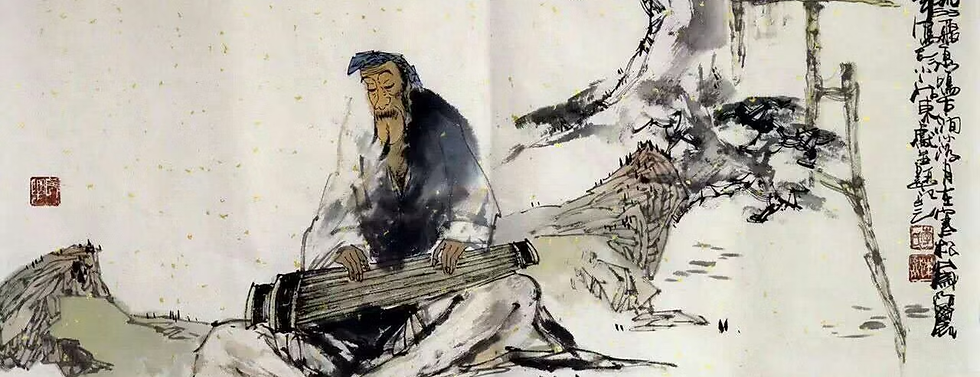
Let us consider my own case: I study, play, and dedicate a significant part of my life to an instrument deeply rooted in Chinese history — the Qin, today recognized by UNESCO as an intangible cultural heritage of humanity.
Of course, an international institution was never necessary to declare the value of this practice. Chinese history itself has continuously done so throughout many centuries. Yet it is interesting to observe the modern necessity of transforming certain practices into “heritage,” as if they needed to become visible within a new global grammar of recognition.
Perhaps this gesture reveals less a need to prove the value of the Qin itself, and more an attempt to create a bridge through which other cultures may establish some form of contact, understanding, and existential relationship with a practice profoundly rooted in Chinese historical experience.
What I wish to emphasize is that this instrument does not merely represent a tradition: it is, in itself, a millennia-old historical and cultural practice.
It is through the Qin that someone external to this culture may perhaps glimpse something of the Chinese experience and, who knows, even be recognized by it — beyond the simple compliment: “You seem so much like one of us!”
But let me be clear: this is not about copying, reproducing, or imitating external signs of Chinese identity. The result of such an attempt would inevitably become caricatural and would fail the first criterion of any genuine transmission: authenticity.
Let us imagine a Japanese samba musician performing Cartola in a small bar in Tokyo. Suppose this musician speaks impeccable Portuguese and has absorbed, with great sensitivity, the vocal, linguistic, and expressive traits associated with Rio de Janeiro’s samba tradition.
Could we say, at least in the realm of artistic expression, that this person participates in something authentically Brazilian?
Perhaps many Brazilians would simply say: “He is Brazilian at heart.”
And perhaps there is nothing more legitimate about such a statement — precisely because determining with absolute certainty what it means “to be Brazilian” is itself an almost impossible task.
We are speaking here about art, memory, and intangible cultural heritage; about symbolic forms transmitted through practices specific enough to constitute extremely long-lasting and fertile imaginary territories.
In the case of the Qin, we are facing a millennia-old musical practice whose historical weight should, at the very least, be approached with due seriousness.
Throughout Chinese history, thousands of individuals have dedicated themselves in different ways to sustaining this place of transmission: an art received from previous generations and carried into the present.
We are speaking of at least 2,500 years of continuous transmission, if we consider the texts, musical treatises, and biographies of its most important practitioners.
In this sense, determining what it means to fully belong to this tradition becomes even more complex, since belonging does not depend solely on origin, but on a constellation of representations, knowledge, practices, and social recognitions capable of sustaining a symbolic position.
In other words, perhaps one can only truly represent a tradition when reaching a form of expression so deeply integrated that the very question of legitimacy begins to disappear.
✫
Today, when observing digital platforms such as YouTube and Bilibili, I see a proliferation of performances in which Chinese musicians appear dressed in clothing inspired by historical periods — long robes and garments associated with dynasties of the past — while interpreting traditional repertoires.
Naturally, clothing works as a powerful sign of continuity. It creates an immediate visual bridge with an imagined ancestry1.
Yet precisely for this reason, it becomes interesting to observe that even those born within a culture must constantly reconstruct their relationship with their own past. Tradition never appears before us in a pure state. It is continuously reorganized, reinterpreted, and presented once again.
When someone, anywhere in the world, observes a Chinese musician playing a traditional instrument within a carefully constructed setting, wearing garments associated with other historical periods, they are immediately captured by a certain fascination.
Perhaps this fascination emerges precisely from the tension between familiarity and strangeness: what we perceive as different often seduces us because it also reveals something about ourselves.
Up to this point, we could understand all of this within a broad contemporary cultural performance, oriented toward making historical memory perceptible once again.
However, what truly interests me is the sense of inadequacy experienced by almost everyone who dedicates themselves to studying a cultural practice as ancient as the contemporary world itself.
Would there be, among these practitioners, a definitive division between Chinese and non-Chinese? Between those who naturally belong to this tradition and those who merely approach it?
The question is perhaps far more complex.
When we ask “what does it mean to be Chinese?”, we realize that this question often carries within itself the expectation of a totalizing answer — as if there were a complete set of elements that, once gathered together, would finally authorize someone to occupy such a place.
Within the context of the Qin, we might formulate this question differently:
What does it mean to become a legitimate representative of this tradition?
Would it require mastering all cultural codes associated with the Qin? Would it demand a profound knowledge of classical Chinese literati culture, an understanding of its texts, poetry, philosophical references, and historical contexts, alongside an exceptional technical and expressive mastery of the instrument?
Certainly, all these elements belong to the horizon of this practice.
However, if they are understood as an absolute totality, a problem emerges: How many individuals could truly sustain such a position?
Perhaps very few.
And it is important to remember that this does not concern foreigners alone. Even within China itself, being recognized as a true representative of a tradition is not something ordinary. It is usually reserved for those who, for different reasons, come to embody a historical continuity considered exemplary.
For this reason, many practitioners remain within a somewhat undefined region. As if we were always halfway there — or perhaps forever standing at the beginning of the path.
We are welcomed with curiosity, enthusiasm, and often sincere generosity. Yet it is difficult to cross that invisible threshold where one ceases to be someone who “studies a tradition” and becomes someone who effectively participates in its continuity.
✫
Then another question emerges:
How can we think about a cultural practice such as the Qin once it begins to move beyond its original historical contexts?
What happens when an art cultivated for centuries within a particular symbolic territory begins to take root in other soils?
Before moving further, however, it is necessary to make an important observation regarding Chinese diasporas — communities that, while living outside their original territory, develop their own forms of cultural continuity.
Diasporic experiences often exist within a space of confluence: they preserve connections with Chinese cultural memory while inevitably entering into dialogue with the cultural contexts in which they exist. In this sense, it is entirely possible to speak of authentically Chinese cultural practices outside China.
However, it would be simplistic to assume that every diasporic process necessarily produces an equal fusion between cultures. Often, especially in the field of traditional arts, diaspora operates precisely through the opposite movement: through the careful attempt to preserve continuity.
Openness toward the other and the preservation of symbolic boundaries are not necessarily opposing forces. Very often, they coexist.
Even though every cultural practice absorbs — frequently in unconscious ways — elements from the different contexts where it establishes roots, one question remains:
“While transmitting this knowledge, am I still preserving the values received from those who came before me?”
Perhaps this is one of the deepest questions faced by anyone who becomes an agent of cultural transmission.
Perhaps there is, within this question, a silent fear of betrayal: the fear of betraying one’s own culture and its original roots.
Could there be an internal pressure not to move too far away from what has been received?
Could there be a need to preserve certain ancestral values with the greatest diligence, so that the symbolic territory connecting individuals to their own history is not lost?
These are profoundly interesting questions — at least for those who dedicate themselves to the humanities and to understanding the social, cultural, and psychological processes through which individuals and communities create meaning.
Many reflections emerge from a question that appears deceptively simple.
Yet this is not exactly why I am writing this essay.
✫
The point I wish to reach concerns precisely this intermediate space — this threshold inhabited by those who do not originally belong to a tradition, but who nevertheless dedicate a significant part of their lives to preserving, studying, and transmitting it.
In the case of Western practitioners deeply involved with the Qin, perhaps there will always be a paradoxical condition:
We are not direct heirs of this historical memory, but we are no longer mere observers standing outside it.
We exist somewhere between these two worlds.
And I do not say this as a negative criticism of the ways in which a cultural tradition preserves its symbolic boundaries.
Quite the opposite.
Although it may seem that I am speaking only about myself, I am also thinking of all those who sustain similar positions when facing traditions that cross cultural borders.
Perhaps the difficulty in accepting, recognizing, or legitimizing certain forms of foreign participation in historical heritages such as the Qin is, above all, a form of cultural resistance.
But resistance does not necessarily mean closure.
It can also represent a force of permanence: an attempt to preserve the continuity of certain values in the face of a present marked by speed, the dissolution of references, and the constant transformation of everything into immediately consumable experiences.
Resistance is also a way of interpreting a culture. It is a way of affirming that certain practices require time, care, and continuity in order to remain alive.
It is also a way of locating oneself historically: walking against the current, against the absolute presentification of everything, and constructing another form of existence — one made above all of slowness, patience, and permanence.
I recognize all of this as profoundly necessary.
At the same time, we must admit that not everyone is willing to perceive value beyond the initial question: “What does it mean to belong to this tradition?”
Or worse: to remain attached to the idea that there is an absolute separation between those who were born within a culture and those who, coming from elsewhere, dedicate their lives to caring for part of that same heritage.
✫
If you have reached this point, you certainly understand that this is a delicate subject.
One that easily awakens reactions because it touches precisely upon the boundaries through which we define belonging, memory, and identity.
For this reason, before raising epistemological walls or aiming theoretical cannons, perhaps it is worth remaining a little longer before this question.
Perhaps it is worth standing, for a moment, before the gate.
At least if we consider that the presence, dissemination, and continuity of this art beyond Chinese contexts also constitutes a singular phenomenon — and perhaps a new page within the long history of the Qin.

Comentários